
Julie Vigneron · Watercolour artist near Lille (North of France)
Welcome to my little corner of the web.
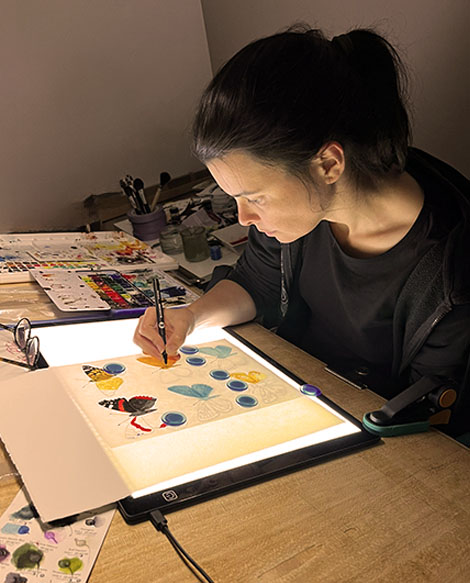
Here, I share my work as a visual artist, my approach to painting with watercolour on paper, and life inside my studio in Northern France, near Lille.
I use this traditional painting technique to create colourful, figurative and inspiring images, whether they are personal artworks or commissioned illustrations. Through my work, I seek to contribute, on my own scale, to a more desirable future that respects the limits of our planet.
This page is an invitation to discover more about who I am, what drives me, and why I create, whether you are here out of curiosity, because you would like to organise an event with an artist, collect artworks, or collaborate on an artistic project.
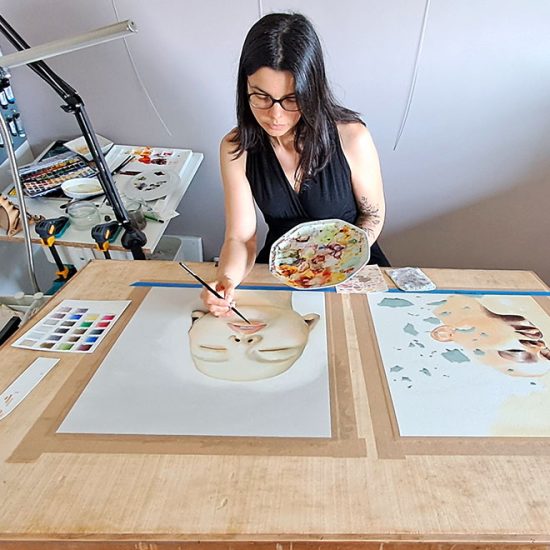
- Julie Vigneron in her studio in northern France
Where do you live and where do you practise your art?
I live in Northern France, between the Lille metropolitan area and the Belgian border, in a village called Camphin-en-Pévèle. This is where I live, paint, create, teach and exhibit my work.
I have a deep affection for my adopted region: the warmth and friendliness of its people, the charm of its brick architecture, the dialogue between the countryside and its international openness…
While my studio is rooted in Northern France, my artistic work reaches far beyond these borders. I collaborate with private clients, companies, publishers and institutions throughout France and internationally.
- Would you like to hear me talk about my work as a watercolour artist?
How did you become an artist?
I have always been drawn to artistic creation. Alongside my other professional activities, I explored different techniques as a self-taught artist.
But I had to wait until I was 35 before allowing myself to truly consider a career as an artist.
I had been searching for meaning for a long time, through my connection with others and my interest in natural wellbeing. One day, I was asked to illustrate a project related to my essential oils business. I allowed myself to create illustrations. Dry pastel drawing, acrylic painting… and then watercolour.
It was a revelation.
Being an artist was no longer a vague dream, but an obvious path. Above all, I realised that being an artist could support my ecological and human aspirations.
Are you a full-time artist?
Yes.
I am a professional artist, and this is now my sole occupation.
Before this, my career took several different paths:
- 10 years working on IT and reporting projects in banking,
- 4 years running my own essential oils consultancy business,
- and even a period working as a childminder.
These experiences may seem far removed from painting. Yet they deeply shape the way I approach my work today.
For me, being an artist is not only about painting. It is also about running a business, organising, communicating, managing projects…
Painting represents around one third of my working time. The rest is dedicated to developing a creative business that is aligned with my values.
What is your work as a painter and artist today?
My activity is built around 3 complementary areas:
- Painting and illustration commissions, for professionals (print and digital illustrations) as well as private clients (personalised portraits),
- Artistic events, to share the joy of painting,
- Personal artistic research, driven by meaningful and committed themes.
Watercolour is at the heart of my work, but it interacts with other tools, including digital techniques, whenever they serve the project or meet my clients’ needs.
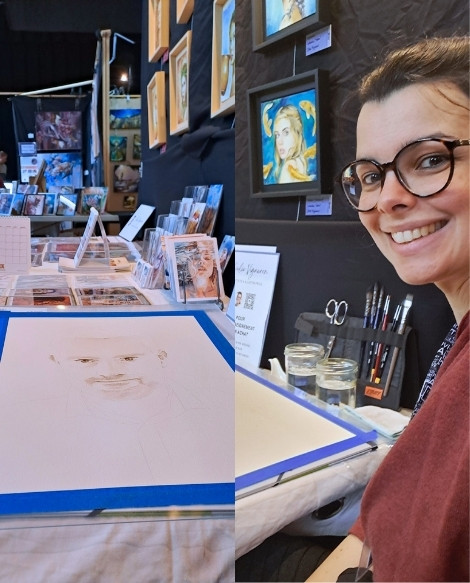
When you think of an artist, you might think of galleries, exhibitions, art valuations…
What about you?
I deeply value artistic encounters, whether at art fairs, collective exhibitions, or through artist groups and associations. The conversations during exhibition openings, sharing ideas and perspectives around artworks, and meeting the public are all an integral part of my work as an artist.
I am fortunate that my personal artwork has found its way into the collections of art lovers in France and the United States.
However, as a significant part of my time is dedicated to commissioned illustrations, I have chosen not to be represented by a gallery or to develop an official market valuation for my work.
This approach allows me to preserve a great deal of artistic freedom, particularly when selecting the projects I take part in, and to create a meaningful dialogue between my personal artistic practice and professional commissions.
Are painting and environmental commitment compatible?
Art is not always perceived as an essential activity. Its environmental footprint can therefore be questioned.
But I deeply believe in the power of brainprint: the positive impact we can have on people’s minds.
For me, painting is a way of reconnecting with our humanity. A suspended, almost sacred moment, where we are reminded of what truly matters. In a time when our sense of direction can feel uncertain, art has this unique ability to enter our everyday lives and plant seeds of meaning.
My commitment is therefore twofold:
– to reduce my material footprint as much as possible,
– and to increase the inspiring impact of my artistic work.
- Would you like to learn more?
How do you limit your environmental impact as an artist?
It is an ongoing journey of continuous improvement, driven by curiosity and a desire to learn.
Art materials: choosing papers, pigments and managing waste
Quelques exemples :
Je privilégie des papiers aquarelle fabriqués en France, notamment les papiers Arches 100 % coton, grain fin ou satiné, en 300 g/m².
Je réalise également des essais réguliers de nouveaux papiers vegan, afin d’élargir mes options de création.
J’affectionne particulièrement les aquarelles extra-fines de Daniel Smith. J’aimerais, à terme, travailler davantage avec une marque française ; toutefois, Sennelier utilise du miel dans la composition de ses aquarelles, et je m’oriente vers des producteurs ne recourant pas à des produits d’origine animale. Je teste ainsi régulièrement des marques artisanales.
Je ne verse pas l’eau de lavage de mes pinceaux dans les canalisations. Je la stocke dans un bac dédié, ce qui me permet de récupérer les résidus secs et de les déposer en déchèterie après évaporation.
J’upcycle mes chutes de papier et de passe-partout, aussi bien pour mon activité artistique (cartels d’exposition, cartes de remerciement…), que pour un usage personnel (étiquettes, éléments de décoration…)
Exhibitions: reusable packaging and shared transport
A few examples:
I use Biyomap reusable protective sleeves, systematically replacing bubble wrap, which is a particularly polluting single-use material.
For my exhibitions, I favour shared artwork transport in order to reduce the impact of journeys between my studio and exhibition venues, especially when they are located far away.
Professional equipment: second-hand, refurbished and refillable
A few examples:
I paint on a former architect’s drafting table, which I bought from a firm that had closed down.
I store my papers in a plan chest purchased from another artist, and my desk is made from an upcycled leftover piece of worktop.
My computer, graphics tablet and smartphone are refurbished equipment.
I chose a cartridge-free printer, and all the small devices I purchase are rechargeable, whether they are wired or powered by rechargeable batteries.
Collaborations: supporting committed partners
A few examples:
I surround myself with a network of committed partners to support my clients’ projects:
I work with a local printer that offers certified papers and is a supported employment company, providing jobs for people with physical disabilities and helping them transition into mainstream employment.
When needed, I collaborate with a graphic designer specialised in eco-design.
I am also preparing for my retirement by making environmentally responsible financial investments aligned with the objectives of the Paris Agreement.
Collaborations: I favour projects with committed partners
Responsible brands, cultural institutions, charitable causes…
- I enjoy collaborating with organisations that seek to create better, communicate differently, and connect with their audiences in a more genuine way.
They may have been committed to more responsible practices for a long time, or they may just be beginning to transform the way they operate.
Example: Minuit sur Terre, ethical and vegan fashion. - I also dedicate my time to non-profit projects when the cause resonates with me.
Example: the Astro series for Les 111 des Arts, art and solidarity in support of the fight against childhood cancer.
This reflection is nourished by:
- regular monitoring of committed media outlets and organisations,
- training programmes such as Créateurs Rev3, Graphic for Good and Web for Good,
- collective initiatives such as La Fresque des Nouveaux Récits and YesWeekLean.
Why choose watercolour painting in the age of artificial intelligence?
I have a deep attachment to the gesture, to handmade work, and to taking the time needed to do things well. Looking at a hand-painted artwork creates a rare emotional connection.
I love the sensations that come with the creative process: the smell of damp paper, the way pigments flow and blend through water, the gradual emergence of a subject beneath the brush…
Watercolour painting also invites me to embrace a slower pace, a time for contemplation, reflection and artistic development.
This does not mean I reject the world I live in. I use digital tools whenever they serve the project: to sketch, compose, project, adapt or create variations of my artworks, particularly for illustration projects intended for publishing or digital media. Digital technology then becomes a creative ally, without ever replacing the gesture, the material and the human presence behind the work.
What is the most challenging part of being an artist?
Other people’s perceptions.
The artistic experience is so personal that I should not be affected when some people do not appreciate my work or underestimate its value. And yet, throughout my different professional activities, the gap between the effort invested and the recognition received has always been a sensitive point for me.
I do not believe in innate talent. I believe in having the courage to allow yourself to create, in patient work and in perseverance.
In my family history, several artistic figures chose to become artists later in life. Their journeys deeply inspire me, both through the idea that anything is possible at any age, and through the path they have travelled, something that becomes visible when you observe how their work evolves over the years.
How did you learn painting and the craft of being an artist?
As a child, I spent almost all my holidays with my grandparents. My grandfather, who became a watercolour artist later in life, painted the landscapes of his region. He tried to teach me, but I did not enjoy painting at the time. I found watercolour too unpredictable. I preferred watching him work, without realising that his gestures were quietly becoming part of my memory.
Today, I am largely self-taught. I progress through practice, observation and experimentation. I also continue to train, both in technical skills and in the entrepreneurial aspects of being an artist, learning from other professionals and specialised organisations.
How would you describe your painting style?
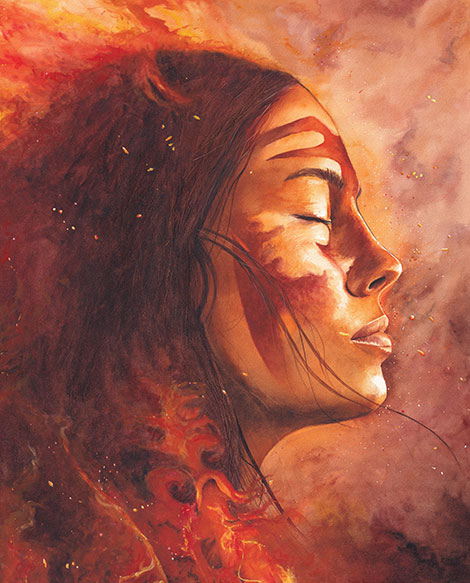
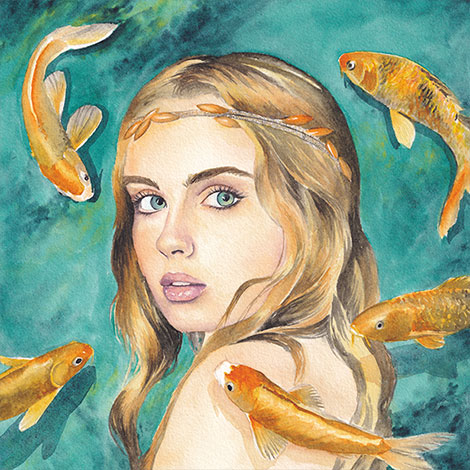
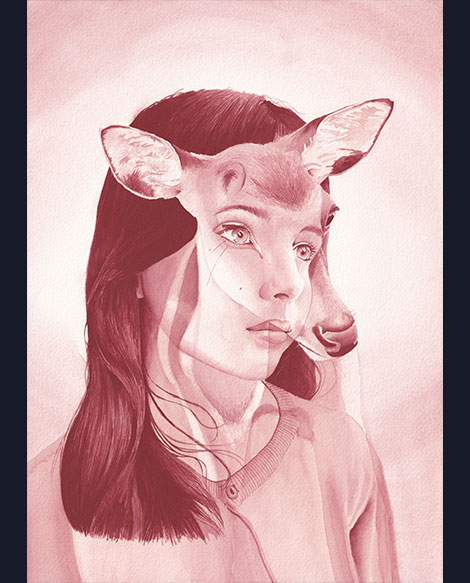
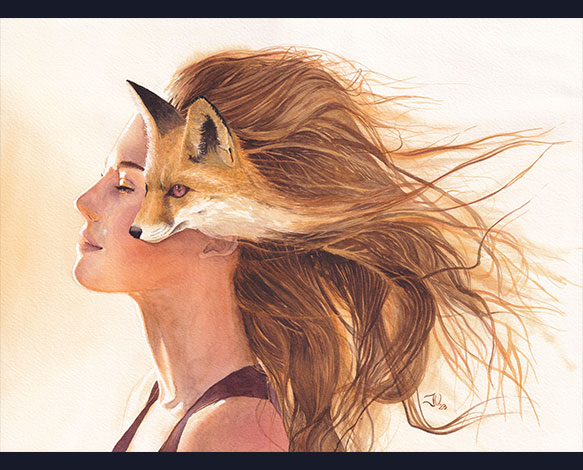
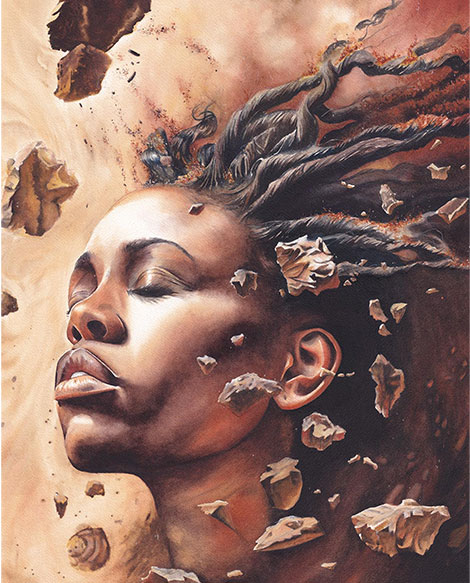
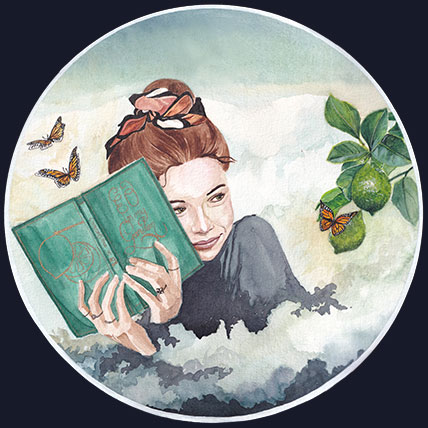
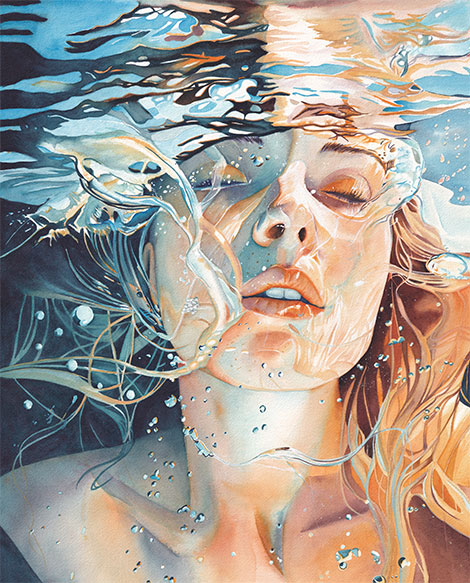
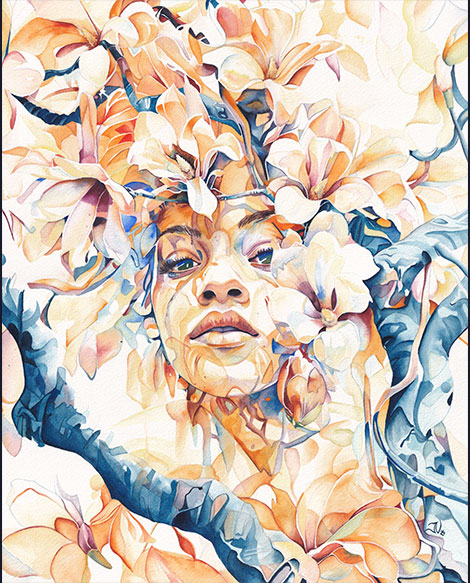
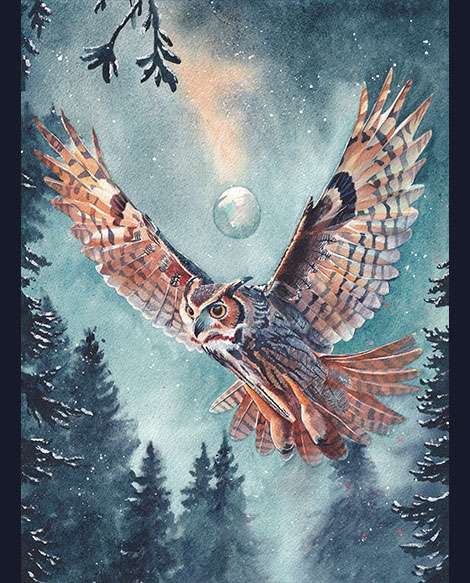
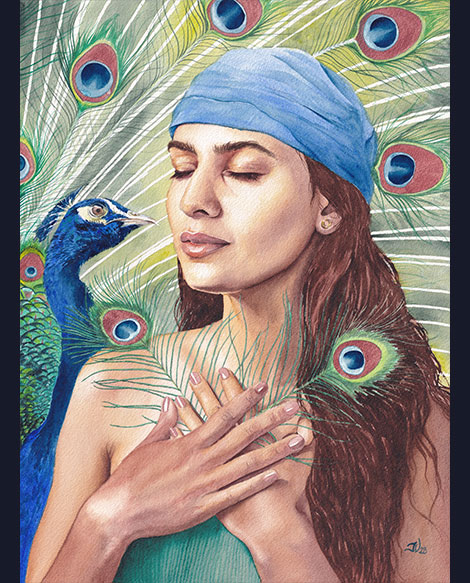
My watercolours are figurative and realistic, with a focus on the sincerity of portraits, but they are also often dreamlike in their combinations and compositions.
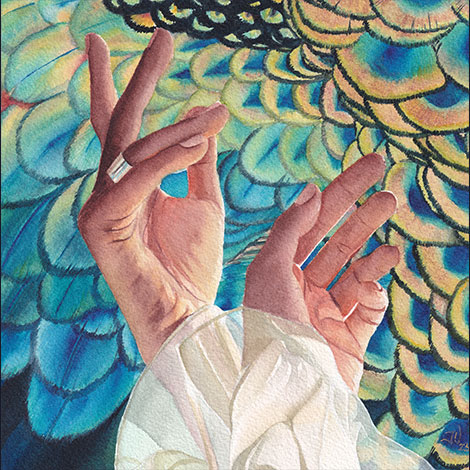
I enjoy blending different artistic worlds: creating a dialogue between a human portrait and an animal portrait, combining natural or symbolic elements with a face, or placing a subject within a semi-abstract background that leaves room for interpretation and emotion.
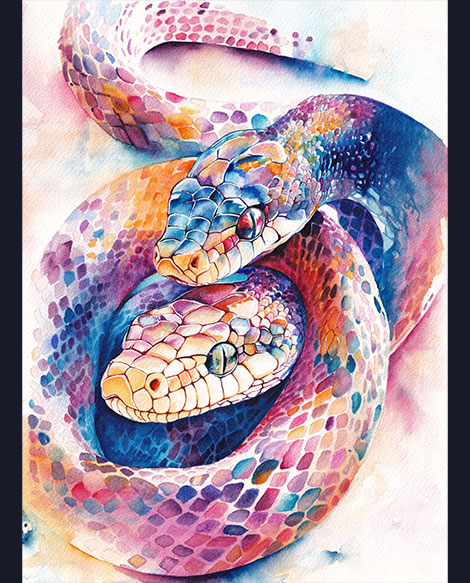
My artworks are highly colourful, with a palette ranging from the pure white of the paper to intensely pigmented shades.
I work with transparent, extra-fine watercolours, applied through successive washes, most often using a wet-on-dry technique. This layering of coloured washes creates subtle depth, a vibration of colour, and gives each painting a presence that feels both gentle and full of life.
Where does your artistic inspiration come from?
I believe we are shaped by what we look at, read and listen to. That is why I choose my influences carefully.
I always paint with music playing. Artists such as Thomas Bergersen, Fox Sailor and Adriel Fair accompany my brushstrokes and fuel my creative energy.
Podcasts, books and encounters with others are also part of this invisible fertile ground that nurtures my work as a painter.
Is sharing painting and creativity important to you?
I am a mother of two. I plant seeds, I encourage, but I never impose.
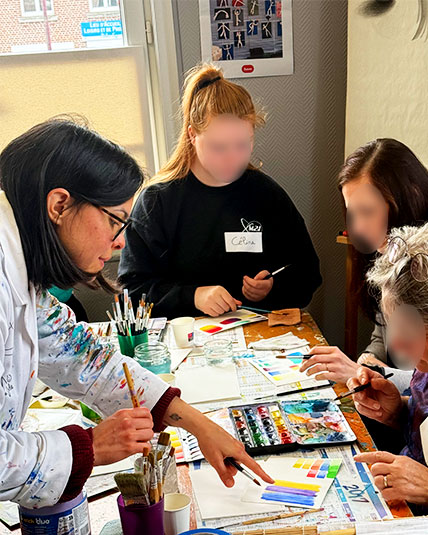
Through my art workshops and private lessons, I support children, teenagers and adults with the same intention: to offer a space where everyone can create freely, with joy, and succeed in expressing on paper what they carry within themselves.